The Real Reason Your Nights Feel Hard
You don't need another list of sleep hygiene rules. You already know about dimming lights, putting the phone away, and taking a warm bath. The reason those tips haven't worked is not because you're doing them wrong. It's because nobody told you why your nights feel like a performance.
When I first started working with people on sleep, I made the same mistake. I gave clients a beautiful 12-step evening routine. They tried it for three nights, felt more anxious, and gave up. The problem was the pressure to execute the routine perfectly. A calm night is not a checklist you complete. It's a felt sense of safety and belonging.
Here's the shortest honest answer to "how to have a calm night": stop treating bedtime as a deadline. Treat it as a return to yourself. Every micro-ritual in this article exists to help you make that shift.
Why Winding Down Feels Like a Chore
The term sleep effort is real. The more energy you put into forcing sleep, the harder it gets. This is one of the best-documented paradoxes in sleep science. When you tell yourself "I must fall asleep in the next 20 minutes," you trigger your sympathetic nervous system. Your body shifts into alert mode because now there is a performance metric to hit.
Most people don't realize that the resistance they feel at night is often not about sleep at all. It's about the day that didn't end cleanly. You carry unresolved emails, conversations, and worries to bed. Then you try to stuff them into a drawer labeled "tomorrow." Your mind refuses because it knows you'll forget something important.
This is why revenge bedtime procrastination is so common. You stay up late scrolling because it's the first time all day you have no obligations. The calm night you want is not about falling asleep faster. It's about reclaiming that unhurried feeling during waking hours, so your brain doesn't have to grab it at midnight.
A calm night isn't a routine you perform. It's a place you come home to.
The Return Protocol: A Framework for Calm Nights
Instead of giving you another static checklist, I want to offer a four-phase framework. I call it the Return Protocol because each phase helps you come back to yourself rather than escape the day.
- Reframe - Change the story you tell yourself about night.
- Release - Let go of the day's physical and mental grip.
- Restore - Offer your senses cues of safety.
- Return - Treat sleep as a homecoming, not a deadline.
These phases don't have to happen in a perfect order. Some nights you might need to start with Release because your body is tense. Other nights you'll need to sit in Reframe because your mind is spiraling. That flexibility is the point. The protocol adapts to you, not the other way around.
Reframe: Change the Story You Tell Yourself at Night
Before you do anything practical, check your internal script. What do you say to yourself when you get into bed? If it's anything like "Why can't I just sleep? Something is wrong with me," you are already in a fight with the night.
A more helpful thought is: "I don't have to fall asleep right now. I just have to rest." This is not a motivational slogan. It's a physiological hack. When you remove the demand to sleep, your brain stops treating bed as a high-stakes situation. The paradoxical intention technique has been used in cognitive behavioral therapy for insomnia for decades. The idea is to give up the effort so hard, the natural process takes over.
I remember a client who said, "But if I don't try hard, I'll stay awake all night." I asked her to try one week of telling herself "I get to stay awake as long as I want, but I must stay in bed with the lights off." Within four nights, she was falling asleep faster than she had in months. She wasn't trying to sleep. She was simply giving herself permission to exist in the dark.
You can also use this time to normalize wakefulness. If you wake up at 3 AM, it's normal to be awake for a few minutes. The problem is when you panic. Tell yourself: "This is a natural sleep cycle, not a crisis. My body knows what to do."
Release: Let Go of the Day's Grip
Once you reframe your expectations, you need to physically and mentally release the day. This is where 3-minute gratitude actually works, but only if you do it in a specific way. Sit on the edge of your bed, close your eyes, and name three things that happened today that you would normally overlook. Not big wins. Single out the small moments: the taste of your coffee, the color of a leaf on your walk, a text from a friend.
Why does this help? Because gratitude is an attention skill. It trains your nervous system to notice safety cues instead of threats. If your day felt like a blur of stress, this practice forces your brain to find moments of safety. Over time, the evening becomes a time when your brain searches for what went well, not what went wrong.
I also recommend a 2-minute temple massage. Place your middle and ring fingers at your temples and make slow circles for 60 seconds. Then slide your fingers to the base of your skull and apply gentle pressure for another 60 seconds. You will feel your jaw unclench and your shoulders drop. This is not fancy, but it works because the jaw and scalp hold a surprising amount of tension.
If you want something more structured, a body scan is valuable. Start at your toes and work up to your head. The key is not to relax each part. Just notice it. When you simply notice tension in your shoulders without judging it, the muscle often releases on its own.
Restore: Sensory Comfort That Signals Safety
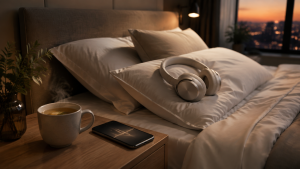
Your nervous system is constantly scanning the environment for clues of danger or safety. You can give it strong safety cues with your senses. This is not about pampering. It's about giving your body tangible evidence that you are not being hunted or rushed.
Weighted blankets are one of the best tools I have seen. The deep pressure touch stimulates your parasympathetic nervous system, which is the rest-and-digest state. A good weighted blanket should be about 10% of your body weight. If you weigh 150 pounds, a 15-pound blanket is a reasonable starting point. Some people feel confined by weighted blankets, but most find the deep pressure calming after a week of adjustment.
Scent is another powerful cue because it goes straight to the limbic system, the emotional part of your brain. Lavender is the most studied calming scent, but it doesn't work for everyone. Some people find it too sweet or even alerting. Try a few options before committing. For a deeper dive, see our guide on how to use scents to drift off faster at night. The important thing is to use the same scent every night so your brain starts to associate it with rest.
Warm baths are not just for muscle tension. When you take a warm bath, your core temperature rises, and then it drops quickly when you get out. This temperature drop is one of the strongest signals your body uses to initiate sleep. Aim for a bath 90 minutes before you want to sleep. The bath itself can be 15 minutes, not an hour-long soak.
One thing nobody tells you about sensory comfort is that your bedroom should feel like an extension of your body. If your pillow is too flat or your sheets are scratchy, that minor irritation can be enough to keep your brain in low-grade alert. You don't need to spend a fortune. Just notice what your skin and muscles are telling you at night.
Return: Make Falling Asleep a Homecoming, Not a Deadline
The final phase is about letting go of the finish line. When you enter bed, you are not entering a performance stage. You are coming home to a body that has been carrying you all day.
One way to practice this is to say a small phrase to yourself as you pull up the covers. "I'm here now. I'm safe enough. Everything else can wait." Repeat it even if you don't believe it at first. The repetition is what matters.
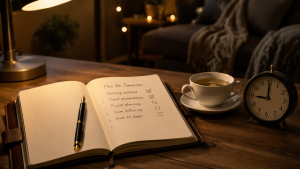
If you struggle with racing thoughts, try this: instead of fighting them, write them on a pad kept next to your bed. The act of writing tells your brain "I've captured this, you can let it go." Do not check your phone or open a notes app. The blue light matters less than the mental activation of reading a screen. A physical pad is better.
When I first tried this, I made the mistake of writing out long paragraphs. It kept me up longer because I was still in problem-solving mode. What worked was writing just one or two words per thought. "Budget meeting. Olive oil. Mom's call." That was enough to unload the mental burden without getting my brain hooked back into analysis.
For more detailed help on the actual moment of falling asleep, read our article on how to fall asleep faster every single night. It complements this emotional approach with practical strategies for the transition itself.
What Actually Calms Your Nervous System at Night
You have probably heard about breathing exercises and meditation. They work, but they aren't magic. The key is knowing which technique matches your state at that moment.
If you are physically tense, start with a body scan or progressive muscle relaxation. If you are mentally agitated with racing thoughts, use the written brain dump or the 3-minute gratitude practice. If you are in a state of unspecified dread or anxiety, slow breathing is your best friend.
For breathing, I recommend the physiological sigh: two short inhales through the nose followed by a long exhale through the mouth. This is a natural way to lower your heart rate. Repeat it five times when you first lie down. You might feel a small yawn or your eyes getting heavy right away. That is your parasympathetic nervous system switching on.
One misconception is that your nervous system has an on-off switch. It doesn't. It has a balance between the accelerator (sympathetic) and the brake (parasympathetic). This is why a single calming activity sometimes isn't enough. You might need to combine a sensory cue (a warm blanket) with a cognitive reframe ("I don't need to sleep") with a body technique (slow breathing).
Avoid doing all three at once, though. That becomes another performance. Pick one that speaks to your dominant state. If you are tense, do the body work. If you are anxious, do the breathing. If you are mentally wired, do the brain dump. You can change techniques any time you want.
Common Mistakes That Keep You Awake Even When You Do Everything "Right"
You can have a perfect evening routine and still end up awake at 1 AM. Here are the mistakes I see most often in my own experience and in other people's stories.
- Checking the clock while practicing a calm routine. This is the fastest way to undo your work. Time tracking puts you back in performance mode. Turn your clock away from the bed or cover it.
- Doing the routine in a rushed or mechanical way. A 2-minute temple massage done while mentally planning tomorrow is worthless. The quality of attention matters more than the length of the ritual.
- Using the routine as a sleep strategy. If you think "I will now do this so I can fall asleep in 10 minutes," you are still pressuring yourself. You have to be willing to let the ritual be an end in itself.
- Making your bedroom too cold or too hot. The ideal sleep temperature is around 65 degrees Fahrenheit, but people vary. If you wake up with sweaty feet or shivering shoulders, adjust accordingly.
- Eating or drinking too late. A heavy meal or alcohol within three hours of bed can fragment your sleep, even if it helps you nod off. For the timing details, check our guide on how to time meals for improved night sleep.
The biggest mistake is treating the routine as a reward for a well-behaved day. If you had a stressful day, you might feel like you don't deserve a calm night. That is the performance mindset leaking into your self-worth. You don't have to earn rest. It is a biological need, not a prize.
How to Adapt This When You're Anxious or Wide Awake at 3 AM
Sometimes the night is already bad. You are lying awake, your heart is pounding, and every calming word you know sounds hollow. This is not the time to start a 20-minute meditation.
First, do the opposite of what your impulse says. Your impulse is to grab your phone and distract yourself. Instead, put one hand on your chest and one on your belly. Breathe slowly. Say to yourself: "This is uncomfortable, but I am not in danger." You might not believe it, but the repetition starts to shift your brain's threat response.
If you are still wide awake after 20 minutes of gentle rest, get out of bed and go sit in a dark corner of your living room. Do not turn on bright lights. Do not eat. Just sit with a glass of water and let your thoughts be boring. The goal is to break the association between your bed and alertness. When you start feeling sleepy again, return to bed.
This is hard to do. I know because I once spent a full week waking up at 3 AM and arguing with my own mind. The thing that helped me was accepting that the wakefulness was not an error. It was my body's way of saying my day hadn't ended, and my brain was still trying to solve problems. Once I acknowledged that, I stopped fighting the awakening. I let it exist. Within a few minutes, my breathing slowed and I drifted back to sleep.
If this happens every night for more than two weeks, consider talking to a healthcare professional. Insomnia can be a symptom of anxiety, depression, sleep apnea, or other conditions. A calm night routine is not a replacement for medical care. It is a complement.
Why a Calm Night Is a Practice, Not a Performance
We have been taught to optimize everything, including rest. But a calm night is not something you can force into existence with a perfect schedule and the right pillow. It is a practice of returning to yourself, again and again, without judgment.
Some nights you will fall asleep quickly. Other nights you will lie awake and wonder if you're doing it wrong. Both are part of the practice. The goal is not to eliminate wakefulness. The goal is to remove the fear around it.
When you accept that you might not sleep well tonight and still choose to be kind to yourself, you break the cycle of sleep anxiety. That acceptance is the foundation of a truly calm night.
If you want to go deeper on the screen side of this, our guide on simple tips to cut out late-night screens covers the practical steps to reduce digital stimulation without feeling like you're punishing yourself. And if you worry that everything you do to fix your sleep will disrupt your daily schedule, our article on smart napping tips without night disruptions will help you protect your nights while recovering during the day.
Your Calm Night Is Not a Measure of Your Worth
Let me be direct: you are not more successful as a human because you fall asleep faster than your partner. Your bedtime routine is not a report card. The pressure to have a perfect calm night is the very thing that steals it from you.
Start small. Choose one micro-ritual from the Return Protocol and practice it for a week. Notice what shifts. Maybe it's the 3-minute gratitude practice. Maybe it's the temple massage. Maybe it's just saying "I'm here now" as you close your eyes.
Treat that one ritual as an experiment, not a fix. If it doesn't help, try another. The goal is to train your nervous system to recognize night as a safe place. That takes time and repetition. You are not behind. You are learning.
A calm night is available to you, not because you finally mastered every sleep hack, but because you gave yourself permission to stop performing. That is the return. Welcome home.