Why Evening Stretching Is Different from Morning Stretching
Most people think stretching is just stretching. But the time of day you do it changes everything. In the morning, your nervous system is still waking up. You need dynamic movement to increase blood flow, raise your heart rate, and prime your muscles for the day. That's why morning routines often include leg swings, arm circles, or cat-cow flows.
Evening stretching serves the opposite purpose. You want to downregulate your nervous system, shift from sympathetic (fight-or-flight) to parasympathetic (rest-and-digest) mode. This isn't just about flexibility. It's about telling your brain, "We are safe. We are done with the day."
When I first started stretching before bed, I made the mistake of treating it like a morning routine. I held deep pigeon poses for two minutes, tried to force a front split, and then wondered why I lay awake with my heart pounding. The problem wasn't the stretch-it was the intensity. Evening stretching should feel like a gentle sigh, not a workout.
The thing nobody tells you about evening stretching is that the goal isn't flexibility-it's neural quieting. You're not trying to lengthen your hamstrings by 10 degrees. You're trying to tell your vagus nerve, "Time to slow down." That means slower pace, shorter holds, and a focus on exhalation.
The Core Evening Stretch Routine (5-10 Minutes)
Below is the routine I've used with hundreds of clients over the past decade. It's designed to be done on a yoga mat, a rug, or even your bed. Each stretch is paired with a breathing cue. Hold each position for 3 to 5 slow breaths. A breath cycle here is 4 seconds inhale, 6 seconds exhale-longer on the exhale to activate the parasympathetic system.
1. Child's Pose (Balasana) with Side Bends
Kneel on the floor, big toes together, knees wide. Sit back toward your heels and extend your arms forward, forehead on the mat. Stay here for 3 breaths. Then, walk your hands to the left, keeping your hips centered, and hold for 2 breaths. Repeat on the right. This gently opens the lats and side body, where a lot of tension from desk work accumulates.
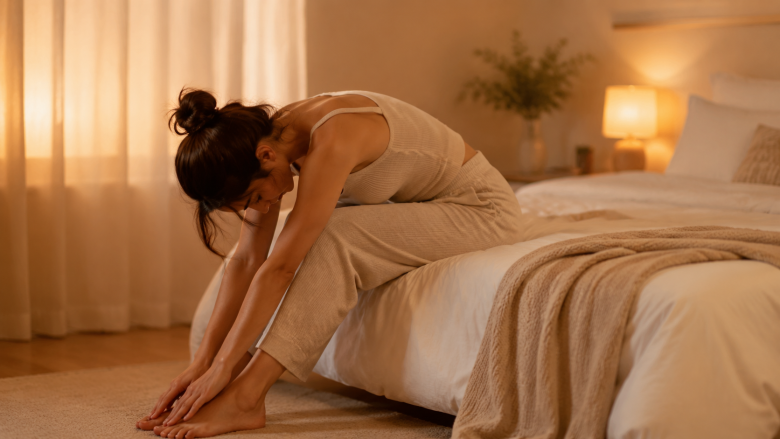
2. Seated Forward Fold (Paschimottanasana) with Bent Knees
Sit with legs extended. If your hamstrings are tight, bend your knees just enough to keep your spine long. Hinge at the hips, not the waist. Place your hands on your shins or feet. Stay here for 5 breaths. Most people don't realize that rounding the lower back in forward folds can actually irritate the discs. Keep your chest open and belly soft.
3. Supine Twist (Jathara Parivartanasana)
Lie on your back. Hug your right knee into your chest, then let it cross over to the left side. Extend your right arm out to the side at shoulder height, and turn your head to the right. Hold for 4 breaths. Repeat on the other side. This is a spinal twist that releases the low back and hips. If you feel a pinch in the lower back, place a pillow under your bent knee.
4. Figure-Four on Back (Supine Pigeon)
Lie on your back with both knees bent, feet flat. Cross your right ankle over your left knee. Flex both feet. Lift your left foot off the floor, and thread your right hand through the gap to clasp your left shin or thigh. Gently draw the left leg toward you. Hold for 4 breaths. Switch sides. For deeper glute release, you can add a light pressure on the right knee away from you.
5. Legs-Up-the-Wall (Viparita Karani)
Find a wall or use the headboard of your bed. Lie on your back with your hips as close to the wall as comfortable, and extend your legs up the wall. Rest your arms by your sides, palms up. Close your eyes. Stay here for 10 full breaths (about 2 minutes). This is the most powerful parasympathetic trigger in the entire routine. It drains fluid from the legs, calms the mind, and lowers blood pressure.
Adapting Stretches for Your Sleep Position and Pain Zones
One size does not fit all. Your sleep position determines which parts of your body are likely to cramp or ache by morning. Here's how to customize the routine.
Back Sleepers
Back sleepers often wake with lower back discomfort because the lumbar spine is unsupported. Add a supine spinal twist (as above) and a gentle knee-to-chest hold. Before bed, try lying on a rolled-up towel under your knees to reduce the arch. In the routine, emphasize psoas release-the hip flexor can get tight from sitting all day. A gentle figure-four stretch on your back (number 4 above) is ideal.
Side Sleepers
Side sleepers tend to develop shoulder and hip tightness on the side they sleep on. Include a side-lying quad stretch: lie on your left side, pull your right foot toward your glutes. Also, a doorway stretch for the chest (pectoralis minor) can prevent the rounded-shoulder posture that often follows side sleeping. In the routine, add a chest opener: lie on your back with a rolled blanket along your spine, arms out.
Stomach Sleepers
Stomach sleeping is the most problematic for neck and lower back. If you can't break the habit, focus on neck stretches: gentle chin tucks and side neck tilts. Also, address the lower back by doing a gentle cat-cow on hands and knees (3 slow rounds) before the supine poses. Avoid deep backbends like cobra-they can worsen extension stress.
Common Pain Zones
- Lower back: Avoid deep forward folds. Instead, do supine twists and knees-to-chest. If you have a disc bulge, skip the seated forward fold entirely and stick to figure-four on back.
- Hips: Glute and piriformis tightness is common. The supine pigeon is your best friend. Hold it for 8 breaths per side, but back off if you feel sharp pain.
- Shoulders and neck: Desk workers often carry tension here. Add a simple thread-the-needle: on all fours, slide one arm under the other, lowering the shoulder to the ground. Hold for 4 breaths.
Mistakes to Avoid
I've seen people sabotage their evening stretch routine more often than I'd like. Here are the most common mistakes.
Overstretching
More is not better. Stretching too deeply-especially in the hamstrings or glutes-can trigger a protective muscle spasm that actually increases tension. The sensation should be a mild to moderate pull, not a sharp stretch. If you feel shaking, you've gone too far. Back off 10% until the trembling stops.
Stimulating Poses Too Late
Inversions like headstands, shoulder stands, and even vigorous sun salutations can raise your heart rate and cortisol. Avoid anything that builds heat or requires strength. Even a fast-paced vinyasa can be too activating within 30 minutes of bedtime. Stick to our routine.
Holding Your Breath
Most people unconsciously hold their breath when they stretch. This defeats the purpose. if you notice yourself tensing, exaggerate your exhale. Make a soft "haaa" sound on the out-breath. This activates the vagus nerve and promotes relaxation.
Skipping the Wind-Down After
The stretch routine is just one part of a broader transition ritual. If you hop straight into bed and scroll on your phone, you've undone the parasympathetic shift. As we discussed in our Simple Evening Wind-Down Routine for Better Sleep, the next 10 minutes matter. Dim the lights, avoid screens, and maybe read a physical book.
Time-Saving Variations for Busy Nights
Not every night can accommodate a 10-minute routine. Here are three variations when you're short on time.
The 5-Minute Bed-Only Routine
Perform these five stretches directly in bed, without getting on the floor:
- Knees-to-chest: Hug both knees into your chest and rock gently side to side. 5 breaths.
- Supine spinal twist (as above, but on your bed). 4 breaths each side.
- Happy baby: Lie on your back, grab the outsides of your feet, and gently pull your knees toward your armpits. 5 breaths.
- Figure-four on back (as above). 4 breaths each side.
- Legs-up-the-wall variation: Instead of a wall, use your headboard or just prop your legs up on a few pillows. 10 breaths.
The 2-Minute Wind-Down
If you're falling asleep standing up, do only two things: lie on your back with knees bent, and do diaphragmatic breathing for 2 minutes. Place one hand on your belly, one on your chest. Breathe slowly so only the hand on your belly rises. This alone can lower your heart rate significantly.
The Chair Stretch (for Travel or Office)
Sit on the edge of a chair. Forward fold with arms hanging down (5 breaths). Side bend to each side (3 breaths). Twist the upper body to the right, holding the back of the chair (3 breaths each side). Finally, stand up and do a wall calf stretch-flex one foot against the wall, keep the heel down (5 breaths each).
When to Skip Stretching (Injury and Acute Pain)
Stretching is not always the answer. If you have an acute injury, such as a muscle tear, a bulging disc flare-up, or a recent surgery, stretching can make things worse. The general rule: if pain is sharp, localized, and increases with movement, stop. Ice and rest are more appropriate.
Even for chronic conditions, some stretches are contraindicated. For example, if you have sciatica that radiates down the leg, the seated forward fold can aggravate the nerve. Instead, try a gentle supine twist or a knee-to-chest on the unaffected side. If you have a history of hip labral tears, avoid deep external rotation (like the full pigeon pose). Stick to the supine figure-four with a pillow under the knee.
Always listen to your body. The goal of an evening stretch routine is to feel better, not to prove anything. If your body tells you "no," that's a valid signal.
How to Build This Into a Bedtime Routine
Stretching works best when it's part of a consistent, predictable sequence. For families, our Family Evening Sleep Routine for Everyone offers a structured approach that includes these stretches adapted for children (shorter holds, more playful names). For adults, consider pairing the stretch routine with a simple winding-down activity, like a warm bath or journaling, as described in our Simple Evening Routine for Deeper Sleep Tonight.
Set a timer for 10 minutes. Put your phone on do-not-disturb. Dim the lights to 20% brightness. Use a candle or red light if possible. The sensory environment matters as much as the movement.
If you're adjusting to a new season, you might need to tweak your routine. Our Seasonal Sleep Adjustment Routine for Changes provides guidance on how changing daylight and temperature affect your body's readiness for sleep.
Final Thoughts
An evening stretch routine is not a magic bullet. It won't fix a broken mattress, a racing mind, or a caffeine habit. But it is one of the most effective, low-cost, drug-free tools you can use to bridge the gap between day and night. The key is to treat it as a transition ritual, not a workout. Slow down. Breathe out longer than you breathe in. Let your body feel safe.
Start with the 5-minute bed-only version tonight. See how you feel. Then adapt it based on your sleep position and pain zones. Over time, you'll develop a practice that not only helps you fall asleep faster but also improves the quality of your sleep. And that's worth a few minutes of stillness.