Why Your Generic Sleep Hygiene Checklist Is Probably Failing You
When I first started coaching people on sleep, I handed out the same standard list: keep a consistent schedule, avoid screens before bed, make your room dark and cool. And most people came back saying, "I did all that, and I still can't sleep." I made the mistake of assuming one routine fits all. It doesn't.
The truth is, the best sleep hygiene routine is the one that works for your biology. Your chronotype, your daytime light exposure, your stress levels, and even your caffeine metabolism speed all play a role. Most people don't realize that following a night owl routine while being a natural early bird can actually make sleep worse. So let's move beyond the generic list and build a personalized approach.
I'll share what I've learned from working with hundreds of clients, plus the science that explains why some "universal" tips fail. By the end, you'll know exactly how to design a sleep hygiene routine that actually works for you.
What Is the Best Sleep Hygiene Routine? (The Short Answer)
The best sleep hygiene routine is a personalized set of daytime and evening habits that align your circadian rhythm with your natural chronotype, manage stress before bed, and eliminate hidden disruptors like delayed caffeine metabolism or evening blue light. It's not a one-size-fits-all checklist. It's a system you tweak based on your own patterns.
For example, if you're a night owl forced to wake at 6 a.m., your routine will look very different from a natural early bird who drifts off by 9 p.m. But there are core principles everyone can use: morning sunlight exposure within 30 minutes of waking, strategic napping (if needed), and a wind-down that addresses your specific stress triggers. I'll walk through each piece below.
Morning Light: The Most Underrated Sleep Hygiene Tool
One of the biggest gaps in most sleep advice is the focus on bedtime only. Your sleep quality tonight is largely determined by what you do this morning. Specifically, your exposure to natural light sets your internal clock for the next 24 hours.
When I first started tracking my own sleep, I noticed that days I got 15 minutes of direct sunlight before 9 a.m. led to falling asleep 20 minutes faster that night. The mechanism is simple: morning light signals your suprachiasmatic nucleus (the brain's master clock) to stop producing melatonin and start the day. It also helps set the timing of melatonin release later that evening.
What can go wrong? On cloudy days, indoor light is often too dim to trigger the full effect. Even on overcast days, outdoor light is about 10 times brighter than a well-lit office. So step outside, even for 5-10 minutes. If you live in a northern latitude with dark winters, consider a light therapy lamp (10,000 lux) for 20-30 minutes after waking.
For a deeper dive on how to structure your entire day for better sleep, see our article on Daily Tips for Natural Better Sleep Habits. It covers the full morning-to-evening timeline.
Napping: When It Helps and When It Hurts
Napping is another area where generic advice fails. "Don't nap" is common, but for shift workers, new parents, or anyone with fragmented sleep, a well-timed nap can be a lifesaver. The key is duration and timing.
Most people don't realize that a nap longer than 30 minutes can push you into deep sleep, and waking during deep sleep leaves you groggy (sleep inertia). Worse, a late afternoon nap can eat into your sleep drive, making it harder to fall asleep at night.
Here's my rule of thumb: keep naps to 20 minutes or less, and finish them at least 7 hours before your target bedtime. For example, if you plan to sleep at 10 p.m., no napping after 3 p.m. For shift workers, a 90-minute nap before a night shift can improve alertness, but that's an advanced strategy that requires careful timing.
If you're a new parent struggling with your baby's sleep patterns, our Sleep Regression Calculator can help you predict when your child's sleep might worsen, so you can plan your own naps accordingly.
Stress and Anxiety: The Hidden Saboteur of Sleep Hygiene
You can have the perfect bedroom environment and still lie awake staring at the ceiling because your mind is racing. Stress management is not a soft add-on; it's a core component of sleep hygiene. The issue is that most people try to silence their thoughts without understanding why they're racing.
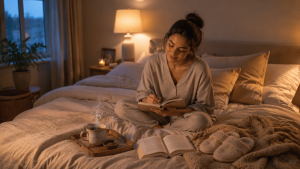
I've found that journaling for 5 minutes before bed works better than any meditation app for many people. The trick is to do a "brain dump" - write down everything on your mind, from tomorrow's meeting to the argument you had with your partner. The act of physically writing moves the thoughts from your working memory to paper, reducing their intrusive power.
Another technique that often gets overlooked is the "4-7-8" breathing pattern: inhale for 4 seconds, hold for 7, exhale for 8. It activates the parasympathetic nervous system. But here's the thing nobody tells you: if you have a panic disorder or high anxiety, the extended hold can feel uncomfortable. In that case, start with a simpler 4-4-4 pattern (inhale 4, hold 4, exhale 4) and gradually work up.
Trade-off: Some people find that writing before bed makes them more alert, not less. If that's you, try a gratitude list instead of a full brain dump. Focus on three specific things you're grateful for that day. It shifts the brain from problem-solving mode to safety mode.
Personalizing Your Routine by Chronotype
One of the most useful frameworks I've learned is the concept of chronotypes - whether you're a morning lark, a night owl, or somewhere in between. Your chronotype is partly genetic, and trying to fight it is like trying to change your height. But you can work with it.
For early birds, the standard advice works well: bedtime around 9-10 p.m., wake up at 5-6 a.m. without an alarm. The challenge is social pressures (late dinners, evening events) that push bedtime later. If you're an early bird, prioritize evening wind-down activities by 8 p.m. and avoid late-night socializing during the workweek.
Night owls face a harder challenge. The world is built for early birds. If you're a night owl with a 9-to-5 job, you're likely sleep-deprived. Here's what I've seen work: shift your wake time as late as possible, but still get morning light. Then use a dim light environment in the evening (start at least 2 hours before bed). Consider a low-dose melatonin supplement (0.5-1 mg) 3-4 hours before bed, not right at bedtime. That's a counterintuitive but effective strategy for delayed sleep phase.
What about the middle group? Most people are "intermediate" chronotypes, flexible but with a slight preference. For you, the standard advice of a fixed schedule works well, but you can experiment with shifting your bedtime by 30 minutes to see if you feel more refreshed.
This personalized approach avoids the trap of doing what works for your friend but not for you. For more specific tips on adjusting sleep with changing seasons, check out our Seasonal Sleep Adjustment Routine for Changes.
Sleep Tracking: Tool or Trap?
Sleep tracking devices (wearables, smart rings, apps) can be useful, but they can also become a source of anxiety. I've seen people obsess over their "sleep score" and wake up feeling worse because they saw a low number. That's the opposite of useful.
Here's my honest take: sleep trackers are good for spotting trends over weeks, not for judging individual nights. If you see that your sleep latency (time to fall asleep) is consistently over 30 minutes, that's a signal to adjust your wind-down routine. But if one night your tracker says you got only 6 hours of deep sleep, dismiss it. The devices are not medical-grade; they estimate using heart rate and movement, and they can be off by 20-30 minutes for deep sleep.
If you decide to use a tracker, set a rule: don't look at the data until after 10 a.m. the next day. That avoids the early-morning anxiety spike. And if you find yourself checking the score multiple times a day, delete the app for a week. You'll likely sleep better without it.
Hidden Disruptors: Caffeine, Alcohol, and Evening Light
Everyone knows caffeine can keep you awake, but the timing is more nuanced than "don't drink coffee after 4 p.m." The half-life of caffeine is about 5 hours, but some people metabolize it slowly due to a genetic variation in the CYP1A2 enzyme. For them, a cup of coffee at noon can still be disruptive at 10 p.m. I've had clients who cut out caffeine after 10 a.m. and saw their sleep improve dramatically.
Alcohol is even trickier. It helps you fall asleep faster, but it reduces REM sleep and causes nighttime awakenings as the alcohol is metabolized. The common advice is to stop drinking 3 hours before bed, but for heavier drinkers, even 4-5 hours may not be enough. If you drink, try limiting to one serving and finish it at least 4 hours before bed.
Evening light exposure is another hidden disruptor. Blue light from screens suppresses melatonin more than other wavelengths, but the intensity matters too. Even a dim screen in a dark room can be enough to shift your circadian rhythm. The best fix is to use "night mode" (warm color temperature) on all devices starting 2 hours before bed, and dim the lights in your home. Better yet, switch to red or amber light bulbs in the bedroom - they have minimal impact on melatonin.
What about eating? Large meals close to bedtime can cause discomfort and acid reflux, but a small snack can actually help. Foods rich in tryptophan, magnesium, or melatonin precursors (like tart cherries, kiwi, or almonds) can support sleep. For a list of science-backed options, see our article on 7 Best Foods That Promote Restful Sleep.
Specific Populations: Shift Workers, New Parents, and Older Adults
Sleep hygiene advice that works for a 30-year-old office worker may not apply to a nurse working night shifts or a parent of a newborn. Let's address these edge cases.
Shift workers: The biggest challenge is maintaining a consistent sleep schedule when your work schedule flips. The key is to control light exposure. After a night shift, wear sunglasses on the drive home to avoid resetting your internal clock. Then sleep in a completely dark room (blackout curtains, eye mask). Use a white noise machine to block daytime sounds. If you have consecutive night shifts, try to keep the same sleep schedule even on days off-but that's hard. A compromise: shift your sleep by no more than 2-3 hours on days off to avoid social jet lag.
New parents: You're sleep-deprived, and the standard advice feels impossible. Focus on sleep hygiene in small doses: nap when the baby naps (even 10 minutes helps), use a sleep tracker (like the baby's sleep regression calculator) to anticipate rough nights, and trade off with your partner for uninterrupted 4-hour blocks. Also, consider keeping the nursery dim at night during feedings to avoid overstimulating the baby's circadian rhythm-and your own.
Older adults: As we age, sleep becomes lighter and more fragmented. The production of melatonin decreases, and the circadian rhythm often shifts earlier (so you get sleepy at 8 p.m. and wake at 4 a.m.). This is normal. Instead of fighting it, adjust your schedule. Push bedtime later if you wake too early, or use a 20-minute timed nap in the early afternoon. Exercise in the morning can help consolidate sleep at night. Also, check your medications-many common drugs (beta-blockers, diuretics, some antidepressants) can interfere with sleep. Consult your doctor before making changes.
A Framework for Building Your Own Best Sleep Hygiene Routine
Instead of a generic list, here's a step-by-step process you can use to design your own routine. I call it the "Personal Sleep Audit."
- Track your baseline for one week. Note your bedtime, wake time, how long it took to fall asleep, and how many times you woke up. Don't use a tracker if it causes anxiety-just use a paper log.
- Identify your chronotype. Are you most alert in the morning, evening, or neither? The Morningness-Eveningness Questionnaire (MEQ) is a free online tool that gives you a score.
- Set your ideal wake time first. Your bedtime will follow naturally. If you need to wake at 6 a.m., calculate your bedtime based on 7-9 hours of sleep. But don't force yourself to go to bed earlier than you feel sleepy-it creates sleep anxiety.
- Optimize morning light exposure. Get 15 minutes of outdoor light within 30 minutes of waking. Use a light lamp if needed.
- Adjust caffeine and alcohol timing. Experiment with cutting caffeine after 2 p.m. (or noon if you're sensitive). Stop alcohol 4 hours before bed.
- Create a wind-down ritual that matches your stress type. Use journaling, breathing, or gentle yoga. Avoid screens entirely for the last 30 minutes.
- Test one change at a time. Change only one variable per week. For example, try adding morning light for a week before changing your caffeine timing. This way you know what works.
- After three weeks, re-evaluate. If you still have trouble falling asleep or staying asleep, consider a professional sleep study (polysomnography) to rule out sleep apnea or other disorders.
This framework avoids the one-size-fits-all trap. It also acknowledges that sleep hygiene is not a magic bullet-if you have an underlying sleep disorder, no amount of routine will fix it. That's a trade-off worth noting.
Common Misconceptions About Sleep Hygiene
Let's clear up a few myths that I hear constantly from clients.
"I need 8 hours of sleep every night." The amount varies by individual. Some people function well on 6.5 hours, others need 9. The National Sleep Foundation recommends 7-9 hours for adults, but it's a range. If you feel rested and don't need caffeine to get through the day, you're likely fine.
"If I can't sleep, I should stay in bed until I do." This is a common recommendation from cognitive behavioral therapy for insomnia, but it's often misunderstood. The actual advice is: if you're awake for more than 20 minutes, get out of bed and do a boring activity in dim light (like reading a physical book). Staying in bed only trains your brain to associate the bed with wakefulness.
"Melatonin supplements are safe because they're natural." Melatonin is a hormone, and taking high doses can disrupt your own production. The most effective doses are low: 0.5-3 mg, taken 1-2 hours before bed. Higher doses can cause vivid dreams, morning grogginess, and even headaches. Use it as a short-term aid, not a long-term solution.
"White noise machines improve sleep." They can help by masking disruptive sounds, but they're not a cure-all. Some people find that constant noise prevents them from reaching deep sleep. If you use one, set it to a low volume (like a gentle fan) and position it away from your head. Alternatively, earplugs work for quiet environments.
When to See a Doctor
Even the best sleep hygiene routine won't fix sleep apnea, restless legs syndrome, narcolepsy, or clinical insomnia. If you consistently have trouble sleeping despite trying these strategies for four weeks, or if you wake up gasping for air, or if you have excessive daytime sleepiness that interferes with driving, see a sleep specialist. According to the CDC, about 1 in 3 adults don't get enough sleep, and up to 10% have chronic insomnia disorder. A professional evaluation can rule out serious conditions.
Remember, sleep hygiene is about creating the conditions for sleep, not forcing it. The more you try to control sleep, the more elusive it becomes. So approach this with curiosity, not pressure. Start with one change-maybe morning light or a 5-minute journal-and see how it feels. Over time, you'll build a routine that's truly yours.